
Generative Engine Optimization (GEO) is the practice of improving website content and online credibility so that AI search platforms can discover, understand and potentially reference a business in their answers.
Think about how a customer researches a service today. Instead of searching for a company name or scrolling through a list of links, they might ask an AI assistant to compare providers, explain costs or recommend a suitable option.
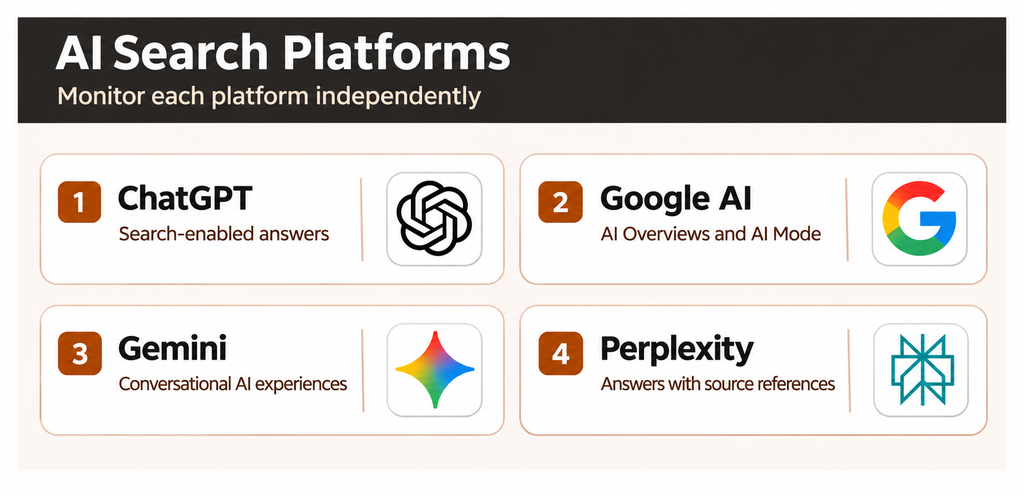
Users can explore topics through Google AI Overviews and AI Mode or conversational platforms such as ChatGPT Search, Gemini, and Perplexity. When these tools consult the web, they can combine information from different sources into a single, contextual answer.
For businesses, this creates another opportunity to be discovered alongside traditional search. GEO helps you prepare for that opportunity without abandoning the SEO work that already supports your website. This guide explains how GEO works, how it differs from SEO, which strategies are worth implementing and how to measure AI search visibility.
What Is Generative Engine Optimization (GEO)?
The purpose of GEO is to establish your website as a valuable information resource for questions your audience asks through AI-powered search. A brand mention introduces your business, whereas a citation directs readers to supporting information. Both can increase online exposure without necessarily generating website traffic.
The focus is not on writing for a particular chatbot. It is on helping people find dependable information wherever they choose to search.
A well-planned GEO strategy focuses on five objectives:
- Make your brand easier to discover in relevant AI answers.
- Improve the potential for individual website pages to earn citations in relevant AI-generated answers.
- Develop recognizable expertise in your industry.
- Address detailed questions at different stages of the customer journey.
- Attract qualified visitors who want to explore your services further.
GEO can improve these opportunities, but no strategy guarantees a citation or recommendation.
How Does Generative Engine Optimization Work?
When a question requires online research, an AI search platform may examine relevant web pages and draw on the information it finds when preparing an answer. GEO helps businesses develop valuable, accessible content that these platforms can discover and potentially reference.
Start by identifying what readers need to know, then make that information easy to find, verify and understand on your website. For example, a small business owner asking which digital marketing channels suit a limited budget needs more than a list of channels. A useful guide explains when SEO, paid advertising or email marketing makes sense, how long each may take and what the trade-offs are.
Why Generative Engine Optimization Matters in 2026
A first-page Google ranking is still valuable in 2026. The difference is that some customers can now learn about your business before they open a website, through an AI-generated response.
Search Behavior Is Changing
A customer can express a specific need, budget or constraint in a single question, rather than relying solely on a short search phrase.
Consider the difference between these example queries:
| Traditional search query | AI search query |
| Best SEO company | Which SEO company can help a small business attract qualified organic leads? |
| Website development services | What should I look for when comparing website development companies? |
| Digital marketing strategies | Which digital marketing channels are suitable for a small business with a limited budget? |
These questions reveal the information a reader actually needs. Your content can address that context rather than simply repeating a target keyword.
The Rise of AI-Powered Search
Pew Research Center analyzed the March 2025 browsing activity of participating U.S. adults. Conventional Google results received a click on 8% of visits with an AI summary and 15% of visits without one. These figures describe observed behavior, not a proven cause-and-effect relationship.
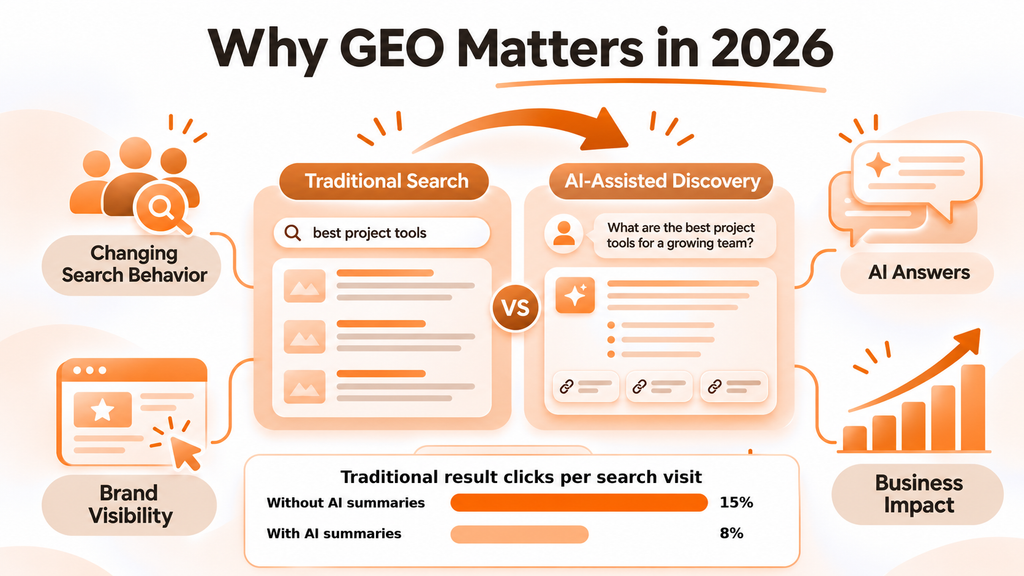
This is why a GEO strategy should consider brand exposure and citations as well as website clicks. The study does not establish the same pattern for every market or AI platform.
The Business Impact of GEO
Being mentioned during an AI-assisted research session can help customers recognize your brand while they are learning about available options. A citation can also give an interested reader a reason to visit your website.
The business benefit depends on relevance: a mention in a buying-related question is more meaningful if your service actually addresses the customer’s need.
GEO vs SEO: Understanding the Key Differences
SEO and GEO overlap because both rely on useful, discoverable content. SEO emphasizes visibility in organic search; GEO extends that work to how information appears in AI-generated responses.
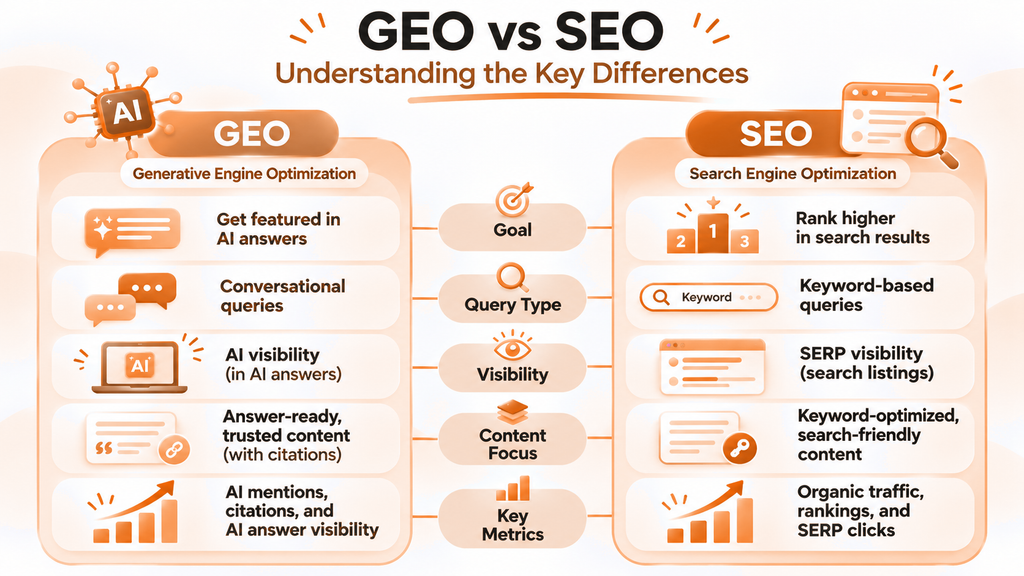
| Factor | Traditional SEO | Generative Engine Optimization |
| Primary objective | Discoverability in organic search | Visibility in AI-assisted answers |
| Search format | Short, long-tail, and conversational queries | Often multi-part or conversational questions |
| Visibility | Search listings and rich results | Answer mentions, citations, and source links |
| Content focus | Relevant, helpful, crawlable pages | Useful, verifiable information suited to the question |
| Key metrics | Organic clicks, impressions, conversions | AI citations, mentions, and referrals |
| Platforms | Google Search and Bing Search | Google AI features, ChatGPT Search, Perplexity and others |
How GEO and SEO Work Together
GEO works best alongside established SEO. Google Search Central confirms that conventional SEO practices remain relevant to AI Overviews and AI Mode. A healthy website, useful information and accessible internal links support both types of discovery.
How Generative AI Search Engines Discover and Cite Content
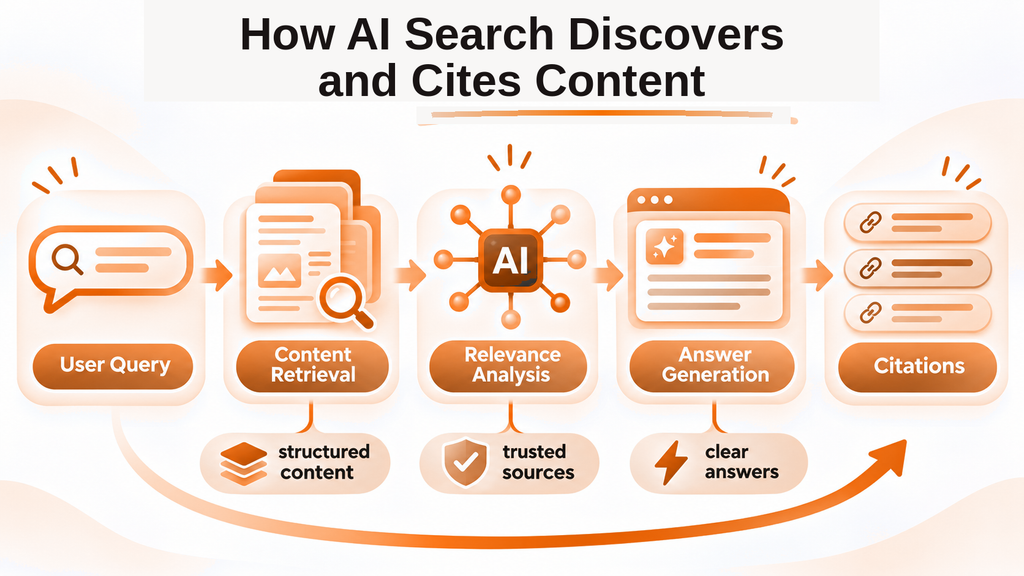
Not every AI response involves a live web search. When a platform retrieves web information, its process can broadly involve understanding the question, finding relevant material, producing an answer and, where supported, displaying references.
Retrieval-augmented generation (RAG), sometimes called grounding, uses retrieved material to inform an AI answer. Google’s query fan-out technique allows AI Overviews and AI Mode to break a complex user request into smaller search tasks. This approach helps these features gather information across multiple aspects of the original query and develop a more comprehensive response.
For a GEO guide, that makes coverage of definition, strategies, limitations and measurement useful to readers with different needs.
What Makes Your Content a Valuable Reference for AI Search Engines?
Although citation selection varies and complete selection methods are not public, the following qualities make a page worth considering as a source:
- Answers that address a specific question without unnecessary filler.
- Facts that are accurate, contextualized and traceable.
- First-hand examples, original analysis or meaningful comparisons.
- Readable text that users can navigate and search systems can access.
- Clear evidence of relevant expertise and responsibility for the content.
- Information that is maintained when facts or products change.
A useful test is whether a reader can verify a claim and act on it without having to guess what the author means.
Generative Engine Optimization (GEO) Strategies for AI Search
Start with the questions your customers ask most often. The following six strategies connect that research with the content, technical and reputation work needed for GEO.
1. Understand Conversational Search Intent
Review actual customer enquiries, search queries, sales conversations and competitor pages. Record the questions people ask before they understand a service, when comparing providers and when they are ready to buy.
Group related questions by intent. A single well-developed guide can answer several closely related questions; you do not need a separate page for every keyword variation.
2. Create Helpful and Expert-Driven Content
Google describes experience, expertise, authoritativeness and trustworthiness as E-E-A-T. It is a useful framework for reviewing content quality, not a standalone ranking factor.
- Experience: Show what you learned from real projects or tests.
- Expertise: Explain methods, decisions and limitations clearly.
- Authoritativeness: Demonstrate relevant recognition and a credible track record.
- Trustworthiness: Identify the author, support factual claims and correct errors.
For instance, a GEO guide is more useful when it shows readers how to review a page, compare results and decide what to change, rather than promising better visibility without explaining the process.
3. Improve Content Structure and Readability
Use headings that reflect the reader’s questions. Give the essential answer early, followed by the details, examples or comparisons that make the answer useful. Keep important information in readable text.
For example, replace a vague service description such as “We deliver the best SEO solutions” with specific information: what an SEO audit covers, which deliverables a client receives, what affects the timeline and how results are measured. This gives readers concrete information to compare.
4. Support Content With Original Research
Original research makes a guide more valuable when it provides information readers cannot find in a generic summary. Use real measurements, clearly defined methods and honest interpretations.
The study “GEO: Generative Engine Optimization” by Aggarwal and colleagues, published at KDD 2024, found that certain content changes improved visibility in its experimental generative search environment. Results varied across topics, so the findings should not be treated as a universal ranking formula.
If you test AI visibility yourself, record the prompts, dates, platforms and observed citations. Explain the limits of the test rather than presenting a small sample as proof of lasting gains.
5. Build Topical Authority Through Content Clusters
Create a central guide and connect it to supporting articles that answer distinct questions in depth. For this topic, related guides might cover GEO vs SEO, AI crawler access, GEO tools and AI search performance tracking.
Link from each supporting article to the main GEO guide where it helps the reader. This creates a clear path between related topics instead of competing pages that repeat the same information.
6. Strengthen Brand Authority
Earn credible mentions through industry publications, genuine reviews, partnerships and relevant backlinks. Keep business details consistent across public profiles and avoid artificial endorsements.
Technical GEO: How to Optimize Your Website for AI Search
A helpful article cannot reach its full potential if search systems cannot access it. Technical GEO begins with the same website foundations used for SEO.
Improve Website Crawlability and Indexing
Review your robots.txt rules, XML sitemap, canonical URLs, broken links and indexing reports. Check that important pages return a successful HTTP response and can be reached through internal links.
Keep essential information in accessible page text, even when using infographics. Add descriptive alt text to informative images, and check page speed and mobile usability.
Use Structured Data Correctly
Structured data can help search engines interpret content and determine eligibility for supported rich results. Choose types appropriate to the actual page, such as Article, Organization, Product or BreadcrumbList.
Google does not require special GEO schema or an llms.txt file for its AI search features. Any structured data you use should match the information visible to readers.
Optimize AI Crawler Accessibility
Crawler permissions are a publishing decision. Review which bots can retrieve public pages, and check whether your hosting service, firewall or content delivery network blocks requests.
OpenAI advises publishers who want ChatGPT Search visibility to allow OAI-SearchBot and its published IP ranges. Search eligibility does not guarantee inclusion in an answer.
How to Optimize for Major AI Search Platforms
AI search products differ in how they access and present information. Use a common foundation of reliable content, then check visibility on each platform separately.
Optimizing for ChatGPT Search
Make public pages accessible to OAI-SearchBot if ChatGPT Search discovery is your goal. Test relevant search prompts and record whether the response names your brand or links to one of your pages.
Optimizing for Google AI Overviews and AI Mode
Google AI Overviews and AI Mode build on Google Search. A page must be indexed and eligible for a search snippet to appear as a supporting link. Review indexing in Search Console and keep the content useful for both broad questions and relevant follow-up queries.
Optimizing for Gemini and Perplexity
For Gemini and Perplexity, make factual information easy to find and verify. Test questions that match your services, inspect any cited sources and note which topics your website covers well or still needs to address.
Use comparable prompts across platforms, but do not expect identical results. Search features, available sources and answers can differ.
Best GEO Tools for AI Search Optimization
Choose GEO tools according to what you want to measure: traditional search visibility, website traffic, AI citations or competitor coverage. Different tools answer different questions.
Free GEO Tools
| Tool | Primary purpose |
| Google Search Console | Track organic search performance and available generative AI insights |
| Google Analytics 4 | Track referral traffic, engagement, and conversions |
| Bing Webmaster Tools | Review citations and cited pages across supported Microsoft AI experiences |
| ChatGPT | Research conversational queries and manually test brand visibility |
| Perplexity | Explore AI responses and cited sources |
| Google PageSpeed Insights | Analyze website performance |
Paid GEO Platforms
| Tool | Primary purpose |
| Semrush AI Visibility Toolkit | AI brand visibility and competitor analysis |
| Ahrefs Brand Radar | Brand mentions and AI visibility monitoring |
| Profound | AI search analytics and competitive intelligence |
| Peec AI | AI search visibility and citation tracking |
| Scrunch AI | AI search performance and website accessibility analysis |
Start with the free tools and add paid tracking when you need broader prompt monitoring or competitor comparisons. Check which platforms and regions each product covers. Third-party scores are estimates, not official AI ranking positions.
How to Measure GEO Success and AI Search Visibility
Measure GEO through a mix of visibility and business outcomes. A brand mention, source citation and website conversion are different events, so track them separately. The dashboard below contains illustrative figures, not actual campaign results.
Key GEO Metrics to Track
- AI brand mentions: The number or proportion of monitored answers that name your business.
- AI citations: References to your website in the AI answers or platform reports you track.
- AI share of voice: Your brand’s share of recorded mentions among a defined set of competitors and prompts.
- AI referral traffic: Visits identifiable as coming from AI platforms in your analytics.
- Conversion rate: The share of measured AI-referred visits that complete a chosen action.
- Citation coverage: The number of distinct website pages receiving citations in a given period.
Monitor and Improve GEO Performance
Establish a baseline with a fixed set of relevant prompts. Record mentions, cited URLs and referrals. Repeat tests under comparable conditions and assess sustained patterns rather than single responses.
Use Google Analytics 4 to assess identifiable AI referrals and conversions. Bing Webmaster Tools offers AI citation data for supported Microsoft experiences, and Google Search Console reports search performance and available generative AI insights.
Common Generative Engine Optimization Mistakes to Avoid
The most common GEO mistakes come from treating AI visibility as a shortcut instead of part of a long-term search strategy. Avoid:
- Repeating a keyword where it adds no meaning.
- Publishing generic or unverified AI-written information.
- Overlooking crawlability, indexing and website accessibility.
- Using statistics without checking their source, date and context.
- Buying irrelevant backlinks or artificial brand mentions.
- Neglecting traditional SEO and the quality of the user experience.
- Expecting guaranteed rankings, citations or immediate results.
When deciding whether a GEO tactic is worth your time, ask whether it improves the information available to a real customer.
How to Implement GEO: A Step-by-Step Guide
Use this 90-day plan to establish a baseline, improve priority pages and begin measuring results. It is a suggested work schedule, not a promise of results within 90 days.
Phase 1: Website Audit and AI Visibility Assessment
Days 1-14: Review indexing, technical issues, current rankings and existing content. Test relevant AI prompts and record which brands and pages appear. Use the findings to prioritize gaps.
Phase 2: Content and Technical Optimization
Days 15-45: Improve high-priority pages, clarify definitions and comparisons, add useful examples and correct accessibility issues. Develop supporting articles around distinct customer questions.
Phase 3: Authority Building and Performance Monitoring
Days 46-90: Build relevant industry relationships, earn credible mentions and repeat your AI visibility tests. Review referrals, leads and cited pages to identify where to focus next.
After day 90, keep the measurement process consistent and revisit pages when facts, products or customer needs change.
The Future of Generative Engine Optimization in 2027 and Beyond
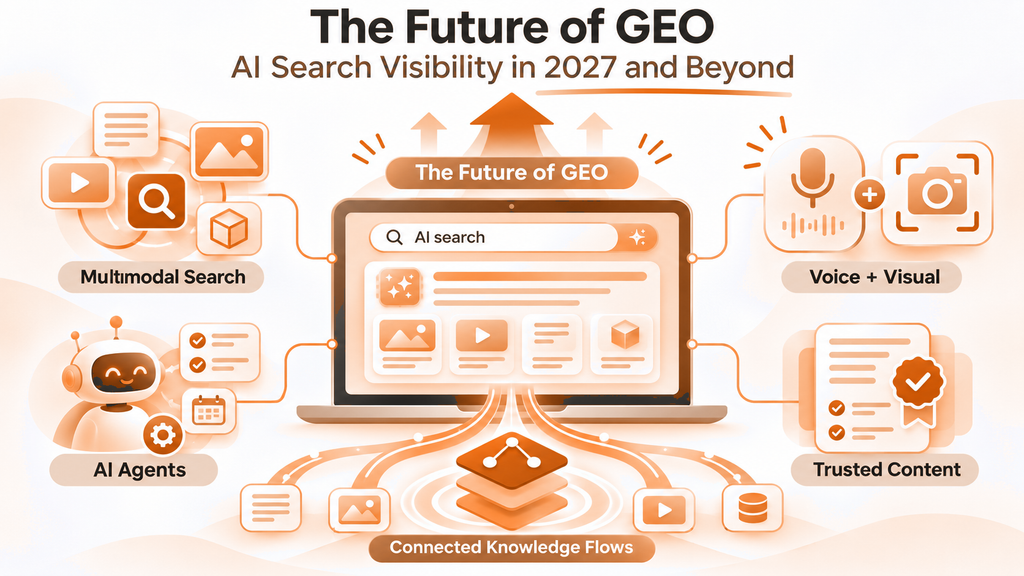
In 2027 and beyond, search may become more conversational and multimodal, with people combining text, images and voice to explore questions. The extent of these changes will vary across platforms and markets.
AI agents may also play a larger role in researching products, comparing services and completing tasks. Clear product details, pricing conditions and accessible website journeys will help people evaluate their options.
Rather than chasing every new AI feature, invest in accurate service information, original expertise and a website that is easy to use and maintain.
The goal remains the same: help people discover your business and make informed decisions, regardless of how they search.
Frequently Asked Questions:-
What is the difference between GEO and SEO?
SEO improves discoverability in organic search results. GEO focuses on visibility within AI responses and supporting citations. The two share many of the same content and technical practices.
How do I optimize my content for ChatGPT?
Allow the relevant search crawler if you want ChatGPT Search visibility, publish useful information for real customer questions and make factual claims clear and verifiable. Placement in an answer is not guaranteed.
How long does it take to see GEO results?
There is no fixed timeline. Results depend on factors such as website accessibility, content quality, competition, search system updates and the questions you monitor.
What content formats work best for GEO?
Use the format that best answers the question: definitions for unfamiliar concepts, comparison tables for choices, tutorials for tasks and original research or case studies for evidence.
How do AI engines decide what to cite?
Search-enabled AI systems may retrieve relevant web information to support their answers. Citation selection varies by platform and query, and the complete methods are not publicly disclosed.
Conclusion
Generative Engine Optimization (GEO) gives businesses another way to reach customers as search moves beyond conventional result pages. It works best as part of a broader SEO and content strategy, not as a replacement for it.
Start with the questions your audience needs answered. Improve the depth and reliability of your content, keep it accessible and build a credible presence around the topics your business knows well. Measure the results that matter: relevant mentions, source citations, qualified website visits and conversions.
CodeBlend Labs helps businesses develop integrated SEO, content optimization and AI search visibility strategies. Explore our digital marketing services to build a search strategy suited to your business.